Every drop becomes intelligent.
MonBleue is building AI for water. A self-powered robotic fitting at every tap, shower and toilet physically collects the information — flow, pressure, temperature, water-quality signals — signs it and transmits it with end-to-end certification of the data. A fully automated water intelligence learns how water moves, is consumed, leaks, warms, changes and is needed, at an exact location; municipalities and water administrators see it and act fast; every liter saved is proven where it was saved.
Sensors observe the physical water environment.
Illustrative simulation
Water is the next intelligence layer.
Electricity got its grid intelligence. Money got its ledgers. Water — the input every city, every chip and every data center depends on — is still managed blind: metered once a month at the property line, leaking in between, and offset in basins far from where it is drawn. Three forces now converge to change that.
AI is thirsty, and it is moving into water-stressed basins.
US data centers consumed 17.4 billion gallons of water directly in 2023 — plus roughly twelve times that indirectly through electricity — and hyperscale sites alone are projected to draw 60–124 billion liters directly by 2028, matching or exceeding the entire 2023 national total.¹ About two-thirds of new US data centers built since 2022 sit in areas of high water stress.² Google, Microsoft, Meta and Amazon have each committed to replenishing more water than they consume by 2030.³ The buyers of verified, basin-located water savings already exist, and they are among the largest companies on Earth.
Infrastructure is at its limit.
Utilities lose 126 billion cubic meters of treated water every year — worth US$39 billion — roughly a third of everything they put into supply.⁴ America’s drinking-water system is graded C−, against a US$625 billion twenty-year investment need.⁵ Inside homes, leaks waste nearly a trillion gallons a year in the US alone.⁶ Regulators are responding: California’s indoor standard falls to 42 gallons per person per day from 2030; Europe’s Water Resilience Strategy puts efficiency first across the bloc; Texas voters approved about US$20 billion for water; and the Colorado River enters tighter operating guidelines from 2027.⁷
The technology just became cheap enough to put intelligence at every fixture.
4.7 billion cellular connections for connected machines are live, and LoRaWAN passed 125 million deployed end nodes, growing about 25% a year.⁸ Micro-sensors, micro-actuators and low-power radios now fit inside a ½-inch fitting — with the compute to run anomaly detection locally, offline, for a design life of up to 20 years.
The infrastructure is failing, the buyers are committed, and the silicon is ready. What is missing is the intelligence layer — a system that knows water. That is what we are building.
Hardware with AI inside. A robotic fleet that learns. A system that predicts.
MonBleue installs where water is actually used — between the wall and the tap, shower or toilet. To the eye it is a hexagonal pipe fitting. Inside, it is a self-powered computer: micro-mechanics that regulate flow, sensors that read flow, pressure, temperature and water-quality signals, and an edge-AI core that decides in milliseconds. Every robotic fitting is a node with an exact location. Above the fleet, a water-data intelligence — a platform of specialized AI agents — observes every point of use, learns, predicts and acts, and every action is verified and written to an immutable audit trail.
Hardware with AI at the point of use.
Flow, pressure, temperature and water-quality signals at every fixture — not inferred from a main-line meter, measured by the fitting itself, at a known location.
Decide at the edge.
Local models detect leaks, micro-flows and anomalies and can throttle or shut a fixture in real time — with or without cloud connectivity.
Orchestrate with agents.
HERMES coordinates specialized agents that optimize usage, monitor risk, learn behavior, serve users and enforce policy — under human-defined boundaries.
Prove every liter.
Signed measurements, basin-locked location and an immutable ledger turn savings into third-party-verifiable evidence — the raw material of water credits.
- SENSE
Sensors observe the physical water environment.
- UNDERSTAND
AI interprets telemetry and context.
- PREDICT
AI predicts leaks, failures, demand and risk.
- DECIDE
Agents determine the optimal action under policy.
- ACT
The system controls valves, alerts and workflows.
- VERIFY
The system confirms the expected result actually occurred.
- LEARN
The system learns from the outcome.
- Sense again
AI automated, robotics executed: the loop sense → understand → predict → decide → act → verify → learn runs automatically — on the robot when the network is gone, within the boundary a person sets.
The system must remain operational even when cloud connectivity is unavailable.
The system that knows water — and what it will do next.
Seven things the Water Intelligence System learns about every point of use, then predicts. Each is sensed by the fitting, understood by local models, and modelled in the digital twin — so a decision made in a guest bathroom and a water balance reported for a basin rest on the same numbers — so a household, a municipality and a basin authority rest on the same physically collected numbers.
Movements
SENSES → LEARNS → PREDICTS
Where water goes after the meter: which fixture, when, for how long, in what sequence. The hydraulic path of every liter inside a home, a tower or a campus — and the flow it will take in the next hour.
Consumption
SENSES → LEARNS → PREDICTS
Liters per fixture, per hour band, per household or floor, against a learned baseline. Not an estimate from a monthly bill: a measured series the system can forecast.
Losses
SENSES → LEARNS → PREDICTS
Leaks, micro-flows, bursts and unbilled water, detected in seconds at the fitting that leaks, quantified per day if left alone — and stopped inside the user's policy.
Temperature & properties
SENSES → LEARNS → PREDICTS
Temperature, pressure and flow regime at every fixture: the energy embedded in hot water, the pressure a building really delivers, the drift that precedes a failure.
Quality
SENSES → LEARNS → PREDICTS
Water-quality signals at the point of use, watched for drift and anomalies over time. Sensing is part of the fitting's design; thresholds and alerts follow the household's or operator's policy.
Needs
SENSES → LEARNS → PREDICTS
Demand for the next hour, day and season — per fixture, building, district and basin — so throttling, deferral and supply planning act on what will be needed, not on what was billed.
Exact geolocation
SENSES → LEARNS → PREDICTS
Every fitting carries its exact location and the hydrological basin it belongs to. A liter is accounted where it was saved — the basis of basin-locked evidence and of district and basin roll-ups.
Values shown anywhere on this page are illustrative simulations; the system is at TRL 5.
02:14. A toilet starts to leak.
An illustrative sequence — what the Water Intelligence System does while a household sleeps. Timestamps and values are simulated.
- Mode
- Autonomous · policy-bounded
- Connectivity
- Cloud optional · edge decides
- Human input
- None required at 02:14
- Evidence
- Signed · timestamped · basin-tagged
- Sense
- Understand
- Predict
- Decide
- Act
- Verify
- Learn
Illustrative simulation · step 01 of 7
Sense
Fitting T-04 (guest bathroom, toilet inlet) reports a constant 0.9 L/min flow with no pressure signature of a flush. 38 minutes and counting.
Understand
Edge model classifies the pattern as flapper-seal leak, confidence 0.97. Not usage. Not a burst.
Predict
Aqua GeniusGuardianAQUA GENIUS projects 1,300 liters lost per day if unaddressed at T-04 (guest bathroom, basin-tagged); GUARDIAN confirms no tamper, no anomalous robot behavior.
Decide
OptimizerGatekeeperOPTIMIZER proposes throttling T-04 to a trickle. GATEKEEPER checks the household policy: “Act automatically on leaks below my risk threshold.” Approved. No human wake-up required.
Act
CareMicro-actuator closes T-04 to trickle. CARE queues a message for 07:00: “We stopped a leak in the guest bathroom overnight. The flapper seal needs replacing.”
Verify
Flow at T-04 reads 0.0 L/min. The measurement pair (before/after) is signed by the robot key, timestamped, basin-tagged and anchored to the audit ledger.
Learn
LearnerLEARNER adds the signature to the household’s twin; the fleet model flags 212 fixtures with an early version of the same pattern.
prevented
technician visits
verified, auditable record
Specialized agents. One orchestrator. Human boundaries.
No single model runs a water system. MonBleue runs a society of narrow, auditable agents, each with one mandate, coordinated by HERMES — the orchestrator that routes context, resolves conflicts between agents and holds the execution order. Agents exchange signed messages over an authenticated channel; none of them can act on a fitting without passing the user's policy first. Together they are the water-data intelligence: models trained on signed fleet telemetry, so a pattern learned in one home is recognised in every home.
- Data flow
- Control flow
- Secure agent-to-agent
- Human boundary
- Verified outcome
- Least privilege
- An agent receives only the context its mandate requires — no shared pool of household data.
- Signed intent
- Every instruction carries the agent that issued it and the policy version it was checked against.
- Reversible by default
- Autonomous actions carry an expiry: unless reaffirmed by evidence, the system returns the fitting to its prior state.
Aqua Genius
Understand & predictUnderstands water data end to end: detects anomalies, runs root-cause analysis and generates insights and predictions for every fitting, building and basin.
Guardian
Detect & protectMonitors risk, fraud, tampering and abnormal robot behaviour; protects the fleet and the infrastructure it touches.
Optimizer
Plan the actionTurns predictions into the smallest effective action: optimizes usage, flow, pressure and energy at every point of use, and reduces loss.
Gatekeeper
Enforce the boundaryEnforces user policies, permissions, consent and access control; gates automation and requires human approval for high-risk actions.
Care
Speak to peopleHandles inquiries, alerts, support and complaints; explains every decision in plain language and hands over the one thing a person needs to do.
Learner
Learn & personalizeLearns behaviour, routines, preferences and risk profile; personalizes recommendations and feeds verified outcomes back into the fleet models.
Agent-to-agent traffic is mutually authenticated and signed; an agent that cannot prove who it is cannot be heard. Every decision carries the identity of the agent that made it, the policy it was checked against and the evidence it produced — which is what makes an autonomous system auditable rather than merely automatic.
One system. Nine planes. Every flow accounted for.
Designed as a deployable global platform, not a diagram. Each plane has a clear responsibility; data, control, agent and trust flows are explicit; security is a plane, not a box.
- Data flow
- Control flow
- Secure agent communication
- Trust & audit flow
Planes 01–03 run entirely inside the property. A severed connection degrades reporting, not protection: the fitting keeps sensing, deciding and acting on the policy it already holds, and reconciles its signed record with planes 05 and 08 when the link returns.
Secure
Security is built into every layer.
Autonomous
AI agents continuously optimize operations.
Intelligent
Raw telemetry becomes actionable intelligence.
User-controlled
Humans define permissions, policies and automation boundaries.
Verifiable
Measurements, decisions and outcomes can be independently verified.
Resilient
Operates through connectivity or infrastructure failures.
Privacy-first
Users and organizations retain control of their data.
Post-quantum ready
Designed for future quantum threats.
Architecture reference v1.0 · September 2026 · Patent-pending items marked (PP) · Component set evolves with certification and field results.
The memory that makes prediction possible.
Intelligence needs a memory. The twin is MonBleue's model of the water it touches — its movements, consumption, losses, temperature, quality and needs, at an exact location — built from the fitting upward, one scale at a time, so that a decision made in a guest bathroom and a water balance reported to a basin authority rest on the same numbers.
Fixture
Is this flow a shower, a dishwasher or a failing seal?
Home
What does normal look like in this household, this week?
Building / site
Where is the loss in a tower, a campus, a data center?
District
Which streets are losing water the utility is still billing?
Basin
How much water was returned to this basin, and where?
Baseline
The twin learns what normal is for each fitting — not a generic threshold. A 0.9 L/min trickle is a leak in one house and a filling cistern in another; the twin knows which house it is looking at.
Simulation
Before an agent acts, the twin runs the consequence: what happens to pressure upstairs if this valve throttles, what the week's demand looks like if nothing is done, what the cost of waiting is.
Aggregation
Fixture events roll up into building, district and basin views without exposing individual behavior — the same evidence that serves a household serves a utility's water balance.
If the system says water was saved, there is evidence — and the evidence is certifiable.
Corporate water commitments fail on measurement, not intent. A pledge needs a number somebody outside the company can check: how much water, in which basin, over which period, against what baseline. MonBleue produces that record automatically, as a by-product of doing the work. Every link of that record sits inside one certifiable chain of custody — see end-to-end certification.
Measure at the source
Fixture-levelVolume is measured at the fitting that used it, not inferred from a main-line meter or a utility bill. The unit of evidence is a liter that did not leave a pipe.
Sign on the robot
Hardware keyThe reading is signed inside the robot by a hardware-held key before it travels anywhere. A record that was altered in transit fails verification.
Lock it to a basin
Basin-lockedEvery record carries the location and the hydrological basin it belongs to. A liter saved in a stressed basin is not interchangeable with one saved elsewhere — the accounting keeps them apart.
Establish the counterfactual
VWBA 2.0-alignedThe twin holds the pre-intervention baseline for that fixture. The benefit claimed is the difference against that baseline, computed with methods aligned to Volumetric Water Benefit Accounting (VWBA 2.0).
Write it once
Append-onlyRecords are appended to an immutable ledger with a time anchor. Nothing is restated after the fact; corrections are new entries that reference the original.
Hand it to a third party
Third-party verifiableThe full chain — robot identity, raw measurement, baseline, method and signature — is exportable for independent review, so the claim can be checked by someone who does not work for us.
- record_id
- wbr_01J8F2K9QX4T7N
- fitting
- MB-050-2A · T-04 · toilet inlet
- basin
- HUC-08 · 03130002
- window
- 2026-04-01T00:00Z → 2026-04-30T23:59Z
- baseline_method
- pre-intervention fixture baseline
- volume_benefit
- 38.4 m³
- accounting
- VWBA 2.0-aligned
- robot_signature
- ed25519:9f4c…a71e
- ledger_anchor
- blk 8,412,904 · 2026-05-01T00:12Z
- status
- registry-ready · not yet issued
What we do not claim
- These records are not certified credits. Certification is a decision for a standards body and a verifier, not for us.
- No credits have been issued. The system is designed to produce registry-ready evidence; issuance follows independent review.
- Accounting is aligned with VWBA 2.0 methodology — alignment is a design choice, not an endorsement by any registry.
End-to-end certification of the data — physically collected, signed, transmitted, auditable.
The information is collected physically, at the fixture, by the robot's own sensors — never inferred from a bill or a main-line meter. From that moment it travels inside one certifiable chain of custody.
Collected physically
Flow, pressure, temperature and water-quality signals are sampled at the fixture by the robot's own sensors. Water-quality sensing is designed in; it is not yet measured at TRL 5.
At the fixtureSigned at the source
The measurement is signed inside the robot, by a hardware-held key that never leaves the secure element and cannot be exported by firmware or by us.
Hardware keyTransmitted with integrity
Mutual authentication on every link, crypto-agile algorithms that are versioned and replaceable in the field, post-quantum ready inside the service life of the robotic fitting.
Mutually authenticatedWritten once
The record is appended once, with a time anchor and a basin lock. Nothing is restated after the fact; corrections are new entries that reference the original.
Append-onlyAuditable by a stranger
The full chain — identity, raw measurement, baseline, method and signature — is exportable for independent review by someone who does not work for us.
Independently checkableDesigned for end-to-end certification. The certification programmes we build against — Common Criteria, ISO/IEC 27001, SOC 2 Type II, NIST post-quantum suite — are targets; none is held today.
Autonomy without security is unacceptable.
A robot that can close a valve in someone's home is a robot worth attacking. We treat every MonBleue fitting as critical infrastructure in miniature: identity in hardware, authority at the edge, and no path by which a remote compromise inherits physical control.
Hardware root of trust
Keys are generated and held inside a secure element on the robot. They are not exportable, not visible to firmware, and not recoverable by us.
Secure boot & signed firmware
The robot executes only firmware signed by MonBleue, verified at every boot. An unsigned image does not run — it does not partially run.
Authenticated agent traffic
Agent-to-agent messages are mutually authenticated and signed. An agent that cannot prove its identity cannot instruct a valve, and every instruction retains its author.
Policy enforcement at the edge
The boundary set by the user is evaluated on the robot before an action executes, so a compromised cloud path cannot widen what the fitting is allowed to do.
Tamper and anomaly detection
Physical tamper, unexpected reboots, clock drift and out-of-profile behavior are treated as security events, not maintenance noise, and propagate to the fleet.
Crypto-agility
Algorithms are versioned and replaceable in the field, so the fleet can migrate to post-quantum primitives without replacing hardware that has a twenty-year design life. NIST published its first post-quantum standards (FIPS 203, 204, 205) in August 2024 and plans to deprecate RSA and elliptic-curve cryptography after 2030 and disallow them after 203510 — inside the service life of every fitting we ship.
Certification targets
MonBleue is engineered against these frameworks. None of them is held today; each is a target the architecture is designed to satisfy when the product reaches audit.
- Common Criteria
- Robot & secure element
- ISO/IEC 27001
- Information security management
- SOC 2 Type II
- Cloud services & controls
- NIST post-quantum suite
- Key exchange & signatures
Threat → control
- Firmware substitution
- Secure boot; signature verification at every start
- Key extraction
- Non-exportable keys in a secure element
- Forged telemetry
- Signing at the point of measurement; verification before ledger write
- Unauthorized actuation
- Edge-side policy check plus authenticated agent identity
- Cloud compromise
- Robot retains policy and autonomy; cloud cannot widen permissions
- Harvest-now-decrypt-later
- Versioned algorithms and a field-upgradable crypto stack
The user is the gatekeeper.
Autonomy is only acceptable where it is bounded. MonBleue splits every possible action into three bands, and the household — or the building operator, or the utility running its own fleet — decides where the line between them sits. Gatekeeper enforces that line on the robot, before anything moves.
Autonomous, inside the boundary
Reversible actions with no comfort impact: throttling a fitting that is leaking, deferring an irrigation cycle by an hour, holding pressure within its normal range.
Closes a leaking toilet inlet at 02:14 and reports it at breakfast.
Acts, then tells you immediately
Actions a person would want to know about at once: isolating a burst line, shutting a supply during an away period, overriding a schedule during a basin restriction.
Shuts the line on a burst, calls the household, holds until acknowledged.
Stops and waits for a human
Anything outside the policy, anything that reduces service to a person, and anything a household explicitly reserved for itself. The system waits, and says exactly what it wants to do and why.
Wants to cap the pool refill during a drought order — asks, and takes no for an answer.
Six things the system can never take away.
These are architectural properties, not settings we promise to honor — the enforcement runs on the fitting, not on a server we control.
Set the boundary
The household or operator defines what the agents may do, per fixture, per hour, per season. The default is conservative and shrinks nothing without consent.
Override at any time
Any autonomous action can be reversed from the app, and every fitting keeps a mechanical path a person can operate without software.
Own the record
The evidence produced in a home belongs to that home. Sharing with a utility, an insurer or a corporate buyer is opt-in, scoped, and revocable.
Keep behavior local
Fixture-level behavior is processed on the robot; what leaves the property is aggregated, and never needs to identify who was in the shower.
Understand the decision
Every action carries a plain-language reason, the agent that made it, and the measurement that triggered it. No unexplained interventions.
Leave
Revoke sharing, export the full record, or return the system to manual. Autonomy is a service the user grants, not a condition of using water.
Free to households. Funded by verified outcomes.
The people who waste water are not the people who need to prove it was saved. Households have no budget for water intelligence and little reason to build one; corporates, utilities and industrial operators have targets, disclosed risk⁹ and no reliable supply of measured, basin-located evidence. MonBleue connects the two: the system is deployed at the point of use at no cost to the occupant, and funded by the parties who need what it produces.
Homes & buildings
Signed measurement leaves the fixture
MonBleue intelligence
Verified water benefit records are produced
Outcome buyers
Funding returns to the deployed system
Homes & buildings
Hardware, install and autonomy at no cost
Deployment segments
Households
InstalledFixture-level valves and sensors across the whole home
Who paysNothing — funded by outcome buyers
What they buyLeak protection, lower bills, autonomy inside their own boundary
Commercial buildings
InstalledRiser, floor and fixture instrumentation with building-level twin
Who paysNothing for the hardware — funded by outcome buyers; operators receive the reporting
What they buyAvoided damage, verified reduction, reporting-grade data
Utilities & districts
InstalledBehind-the-meter fleet feeding district and basin aggregation
Who paysProgramme- or outcome-funded; no cost to households
What they buyBehind-the-meter visibility, loss localisation, demand response, sub-metering
Industry & data centers
InstalledBasin-matched household and building deployments around their sites, plus site instrumentation where useful
Who paysCorporate water or sustainability budget — the outcome buyer
What they buyBasin-located, third-party-verifiable water benefit records
Why the model works
Four structural reasons, none of which depend on a household deciding that water intelligence is worth paying for.
The unit is a verified liter, in a named basin
Value is created when a liter that would have been used is not used, in a place where that matters, with evidence a third party can check. Records are basin-locked, so a benefit in a stressed basin is never traded as if it were anywhere.
Households never pay for the intelligence
Consumer adoption is the bottleneck for every water technology sold on payback maths. Removing price removes the bottleneck: the household grants access to the fixture, the buyer funds the deployment.
Demand exists before supply does
Corporate commitments to replenish more water than they consume are already made and publicly reported, while the supply of measured, basin-located benefits is thin. The scarce good is verifiable evidence, not intent.
Hardware is a twenty-year asset
Fittings are designed for a service life measured in decades, not product cycles. The intelligence on them is upgradable in the field, so the installed base compounds instead of depreciating into replacement.
Municipalities and water administrators see it and act fast.
The same physically collected, certified information that serves a household serves the people who run water. Designed for the operators: consoles, web platform and app.
District and basin roll-ups
Consumption and losses measured at the fixture, aggregated to district and basin without exposing individual behaviour.
Leak, burst and micro-flow alerts in minutes
Located at the fixture, not somewhere along the street — the address, the riser and the fitting are already known.
Non-revenue water behind the meter
The loss the utility bills for but cannot see: measured where it happens, quantified per day, attributable to a point of use.
Demand forecasts
Next hour, day and season — per building, district and basin — so supply planning acts on what will be needed, not on what was billed.
Individual allocation without individual meters
Buildings and condominiums split the bill by measured use, fixture by fixture, without retrofitting a meter per apartment.
Automated action within policy
Robots throttle or close a fixture automatically; the operator sets the boundary and the boundary is enforced at the edge.
Households pay nothing; outcome buyers fund the fleet; municipalities, utilities and building administrators use the information and the actions. Design status: TRL 5 — no customer today.
Where others watch the main line, MonBleue acts at every fixture.
Every existing product in this category observes water from a distance and reports on it afterwards: one sensor on the main, one meter at the boundary, one model of the district. None of them can attribute a liter to the fitting that used it, and none of them can do anything about it. That gap is the product.
Whole-home leak detector
Consumer unit on the main
- Where it measures
- Partial: One point on the incoming main
- What it can do about a problem
- Partial: Shuts the whole property
- Attribution
- Partial: Infers the fixture from flow signatures
- Behaviour without connectivity
- None: Alerts depend on the cloud
- Evidence it produces
- None: An alert history
- Security posture
- None: Consumer connected hardware, cloud-trusting
- Cost to the household
- None: Hardware plus plumber, paid by the owner
Smart meter / AMI
Utility metering at the boundary
- Where it measures
- Partial: Property boundary, hourly at best
- What it can do about a problem
- None: Reports a number; acts on nothing
- Attribution
- None: Aggregate volume only
- Behaviour without connectivity
- None: Data is stored and uploaded later
- Evidence it produces
- Partial: Billing volume
- Security posture
- Partial: Utility metering standards
- Cost to the household
- Partial: Recovered through the tariff
Utility analytics
District telemetry & modelling
- Where it measures
- Partial: District mains and pressure zones
- What it can do about a problem
- Partial: Dispatches a crew, hours to days later
- Attribution
- Partial: Statistical, at zone level
- Behaviour without connectivity
- None: Entirely cloud-side
- Evidence it produces
- Partial: Modelled loss estimates
- Security posture
- Partial: Enterprise IT controls
- Cost to the household
- Partial: Recovered through the tariff
MonBleue
Intelligence at every fitting
- Where it measures
- Full: Every fitting, continuously
- What it can do about a problem
- Full: Acts on the fitting that caused it, in seconds
- Attribution
- Full: Measured at the robotic fitting that used the water
- Behaviour without connectivity
- Full: Full sense–decide–act loop runs on the robot
- Evidence it produces
- Full: Signed, basin-locked, third-party-verifiable records
- Security posture
- Full: Hardware root of trust, signed firmware, policy enforced at the edge
- Cost to the household
- Full: No cost — funded by verified outcomes
Where we are honest about the limits
We are at TRL 5
The fitting's sensing — flow, pressure, temperature and water-quality signals — and its edge AI exist as a validated prototype. Volume production, certifications and field-scale learning are the work of the next phases, dated on the roadmap below.
It replaces a fitting, not a habit
MonBleue installs inline between the wall pipe and the fixture hose — plug-and-play, by the user, in minutes, no technician required. What it does not do is ask people to change how they use water: the saving comes from measurement, control and detection, not from behaviour.
It does not replace the utility's network
Mains, reservoirs and pressure zones still need utility-side instrumentation. MonBleue covers what happens after the meter — the part nobody currently sees — and hands aggregated signal back.
Records are evidence, not yet certificates
MonBleue produces registry-ready, third-party-verifiable records. Certification and issuance depend on standards bodies and independent verifiers, and we describe them as targets, not facts.
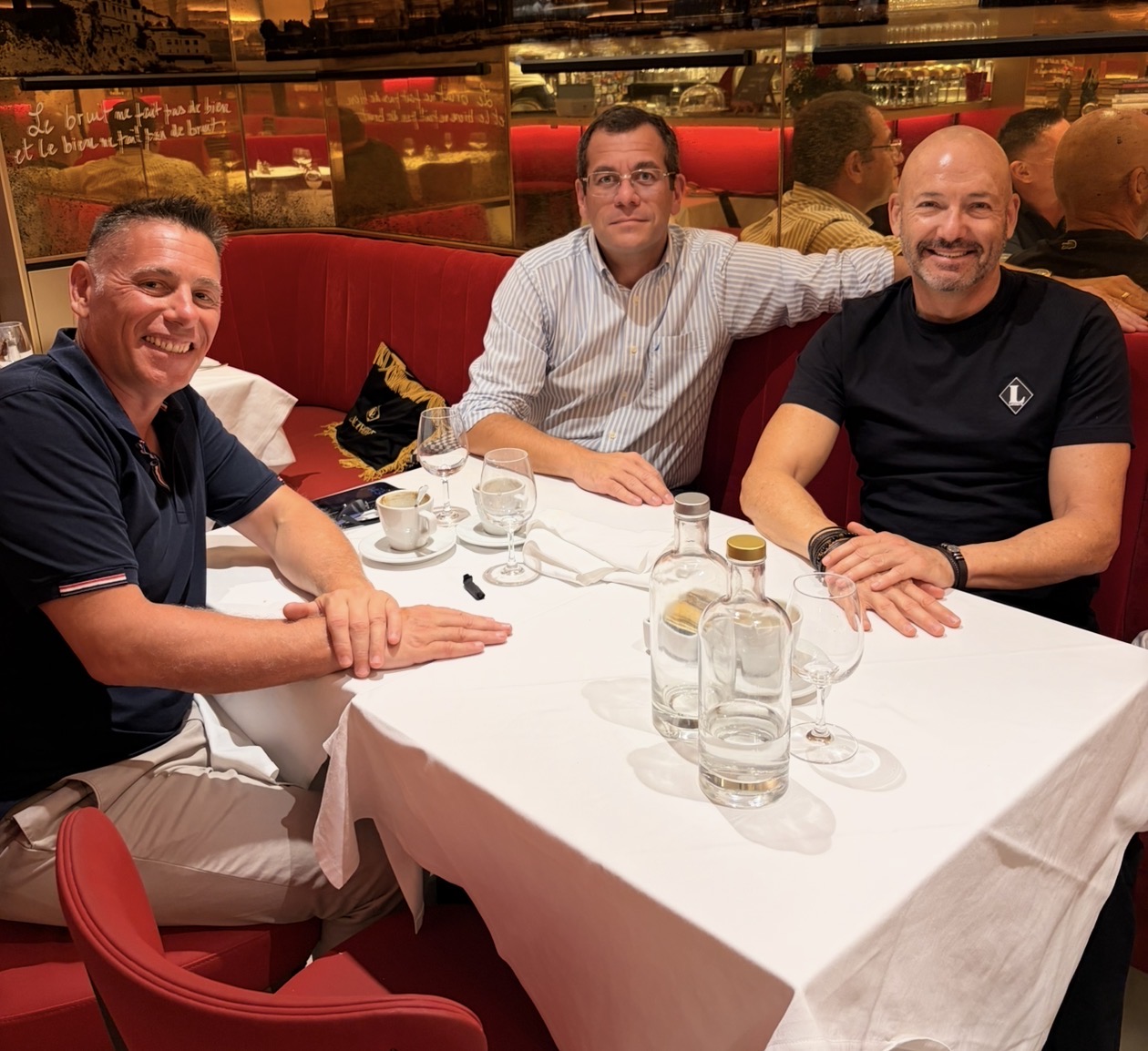
Three founders. One obsession: the basin.
Engineering in water environments, AI at the edge, and defence-grade cybersecurity — in one founding team. Thierry built underwater sensing and telecommunication networks for critical-infrastructure surveillance and led the European AI programmes AI4DI and EdgeAI; Jacob ran the Cybersecurity Center of Excellence at Intel and applied cryptography at State Street and JPMorgan; Rodrigo conceived the basin-locked robotic fitting and the outcome-funded deployment model and has 25+ years building technology and financial businesses.
Rodrigo Füchter
CEO & Co-founder
Entrepreneur since his high-school years, with 25+ years building and running technology and financial businesses. He started out assembling and maintaining microcomputers and networks, moved into building online platforms, and spent nearly two decades inside his family's group as CFO and Head of Compliance, where he gained deep financial and regulatory experience. Throughout, he kept his own in-house development team, shipping countless solutions for the automotive and cross-border financial markets: Serenitech, MonFinance, DebitoPago, CarroPago and Lanet Tecnologia. Conceiver of MonBleue's basin-locked robotic fitting and its self-funded deployment model; leads strategy, capital and the commercial program.
Dr. Thierry Deschamps de Paillette
CTO & Co-founder
Dr. Thierry Deschamps de Paillette is agrégé in electrical engineering and electronics — France’s most selective national competitive examination in the discipline — and holds a doctorate from the Université de La Rochelle awarded with félicitations du jury, the highest distinction. He brings a 27-year track record in advanced research across high-frequency electronics, photonics and systems, applied to AI, cybernetics and multi-domain telecommunication systems in cooperation with industry and defence primes. Founder, CTO and chairman of the Norwegian defence company Havguard, he recently developed a new generation of underwater telecommunication and sensing networks for critical-infrastructure surveillance. He has designed industrial products for two decades — Crouzet, Micrelec, TECHNEXT — and is the named inventor on Havguard’s patent applications for AI-driven selection of underwater communication mode. A higher-chair professor within the French national academic system, he sat on the national boards that recruit agrégés in engineering sciences. He publishes at IEEE and reviews for the IEEE Journal of Oceanic Engineering, and as an AI advisor, speaker and expert in clusters including Institut EuropIA and Cluster-IA he led the European AI programmes AI4DI and EdgeAI with industry primes and startups. He has released both his professorship and his advisory position at TECHNEXT, and now divides his working time entirely between Havguard and MonBleue. At MonBleue he owns robotic-fitting architecture, the patent-pending communication protocols and the AI sensing and edge-intelligence stack.
Dr. Jacob Mendel
CISO & Co-founder
He previously served as Head of Cryptography & Cybersecurity at State Street (UK) and Head of Applied Research at JPMorgan, and was General Manager of the Cybersecurity Center of Excellence at Intel, and Broadcom. In academia, he was Head of Cybersecurity Studies at Tel Aviv University’s Coller School of Management and Head of Industry Research Cooperation at the Blavatnik Interdisciplinary Cyber Research Center.
From TRL 1 to one million intelligent points of use.
T0 — November 2025. Every phase measured, every milestone dated. Hardware, edge intelligence and the agent platform advance on the same clock. We are currently in TRL 5.
Kick-off
Engineering hiring, equipment, software, rapid prototyping (3D printers, electronic workbench, workstations).
Team and lab operational
System design
Systemic SysML design, system fluid key equations, simulation of main components.
Simulation tools, requirements diagrams, mechanical outlines
Component design & architecture
Component design, technology choices, mechanical design, software architecture.
Frozen architecture and component selection
Prototypes, unit tests, first PCBs
Component prototypes, unit tests, software integration, first PCBs.
Tested PCBs, core software functions, unit-test reports, AI functions
Intelligence trackEdge anomaly & leak models; first AI functions on PCBs
Edge anomaly & leak models; first AI functions on PCBs
Assembly & cloud services
Mechanical prototype manufacture, PCB manufacture, prototype assembly, test conditions, cloud services.
Assembled prototypes under test
Intelligence trackCloud services and agent platform v1 (HERMES + core agents)
Cloud services and agent platform v1 (HERMES + core agents)
Functional prototype & MVP
Prototype factory, plastic moulds, on-demand mechanical parts, functional prototype tests, software integration, phone apps, cloud services, AI training.
MVP — functional prototype
Intelligence trackAI training, mobile & web apps, conversational interfaces
AI training, mobile & web apps, conversational interfaces
Field-tested demonstrator
Field tests of the fully functional demonstrator, cloud service, first pre-serial batch, AI training, data collection.
Field-tested demonstrator
Intelligence trackField data collection, fleet learning, digital twins
Field data collection, fleet learning, digital twins
Industrialisation & security validation
Factory and manufacturing production-line design, application security validation, product certification programs.
Secured product design entering certification
Intelligence trackSecurity validation, PQC-ready cryptography, certification programs (targets)
Security validation, PQC-ready cryptography, certification programs (targets)
Production-ready line
Production line setup, secured application deployment, cloud service fully operational, manufacture / logistics / supply-chain setup, test production validation.
Production-ready line
Mass production & deployment
Mass production, logistics and delivery operations, installer training, commercial operations.
One million units produced and delivered; secured data flow; system deployed and monitored
Intelligence trackSecured deployment, monitoring and verified evidence at one million robotic fittings
Secured deployment, monitoring and verified evidence at one million robotic fittings
Verified water benefits begin flowing from the fleet.
Measured savings become basin-locked, third-party-verifiable records, generated continuously by every deployed point of use.
Investor brief →The intelligence layer for water is being built now.
We are raising to complete the hardware, the agent platform and the verification stack, and to put the first basins under continuous intelligence. If you invest in infrastructure, climate resilience or autonomous systems, we would like to talk.
Silicon & edge
Secure element, sensing chain and the edge-AI core taken from tested PCBs to a manufacturable module.
Agent platform
HERMES orchestration, the digital twin and the verification ledger, hardened for fleet scale.
Trust program
Security architecture and audit work designed to target Common Criteria, ISO 27001 and SOC 2.
First basins
Deployment in water-stressed basins with utility and corporate partners, generating verified benefit data.
Every number on this page is checkable.
Market and problem figures cited above carry a numbered marker that resolves here. Where a widely repeated statistic could not be traced to a primary publication, we removed it rather than restate it. Where a figure is a projection or a range, it is labelled as one.
- 01
US data centers consumed 17.4 billion gallons (66 billion liters) of water directly in 2023, with roughly twelve times that consumed indirectly through electricity generation; hyperscale direct consumption is projected at 60–124 billion liters by 2028.
The 2028 range covers hyperscale facilities only; the 2023 figure is the national total across all data centers.
- 02
About two-thirds of new US data centers built since 2022 are located in areas of high water stress.
- 03
Google, Microsoft, Meta and Amazon have each publicly committed to replenishing more water than they consume by 2030.
- Microsoft, “Microsoft will replenish more water than it consumes by 2030” (2020)
- Meta, Sustainability — Water (commitment page)
- DataCenterDynamics, “AWS pledges to be water positive by 2030”
- Google, 2026 Environmental Report
Each company publishes its own replenishment accounting; MonBleue makes no representation about progress against those targets.
- 04
Water utilities lose an estimated 126 billion cubic meters of treated water a year, worth about US$39 billion — roughly a third of the water they put into supply.
- 05
US drinking-water infrastructure is graded C−, with an identified twenty-year investment need of US$625 billion.
The US$625 billion figure is EPA's 20-year needs assessment as reported by ASCE, exceeding its 2018 assessment by more than US$150 billion.
- 06
Household leaks waste nearly one trillion gallons of water a year in the United States.
- 07
Regulatory tightening: California's indoor residential standard falls to 42 gallons per person per day from 2030; the European Water Resilience Strategy puts efficiency first across the bloc; Texas voters approved roughly US$20 billion for water infrastructure in November 2025; and the Colorado River enters new operating guidelines from 2027.
- California State Water Resources Control Board, “Making Conservation a California Way of Life” regulation FAQ (2025); Cal. Water Code §10609.4
- European Commission, European Water Resilience Strategy, COM(2025) 280 (2025)
- The Texas Tribune, “Texas set to make $20 billion investment in water after voters approve Proposition 4” (2025)
- US Department of the Interior / Bureau of Reclamation, 2027–2028 Colorado River Operating Guidelines (2026)
- 08
4.7 billion cellular connections for connected machines were live in 2025, and LoRaWAN passed 125 million deployed end nodes, growing about 25% a year.
- 09
Companies reporting to CDP disclosed about US$339 billion in water-related financial risk, against US$58.7 billion needed to mitigate it.
- 10
NIST finalized FIPS 203, 204 and 205 in August 2024; NIST IR 8547 (draft) deprecates RSA/ECC after 2030 and disallows them after 2035.
Statements of position
What this page claims, and just as importantly, what it does not.
- On credits
- MonBleue produces water benefit records designed to be third-party verifiable, basin-locked and registry-ready, with accounting aligned to Volumetric Water Benefit Accounting (VWBA 2.0). No credits have been certified or issued. Certification and issuance are decisions for standards bodies, registries and independent verifiers.
- On certifications
- Common Criteria, ISO/IEC 27001 and SOC 2 are engineering targets the architecture is designed to satisfy. MonBleue does not hold these certifications today and does not represent that it does.
- On product status
- Descriptions of robotic fittings, agents and services on this page include capabilities under development. Timelines shown in the roadmap are plans, not commitments, and figures used in scenarios are illustrative unless a source is cited.
- On intellectual property
- Where this page marks an element as patent pending, applications have been filed and are not yet granted. No claim of granted patent protection is made.
- On third parties
- Company names, standards and publications are referenced for identification and context only. Their appearance does not imply endorsement, partnership, or review of MonBleue by those parties.